By Tony Doy, Vice President of New Product Development, Triad Semiconductor
For decades, the standard procedure for professional audio equipment — from audio interfaces to mixing consoles — involved a compromise: the need for two separate, parallel signal paths (and usually, dedicated panel connectors) to accommodate the massive disparity between a quiet microphone and a powerful line-level source.
This dual-path design was an accepted flaw, necessitated by the limitations of the traditional balanced Analog Front End (AFE), usually based on some variation of the Instrumentation Amplifier (INA) topology.
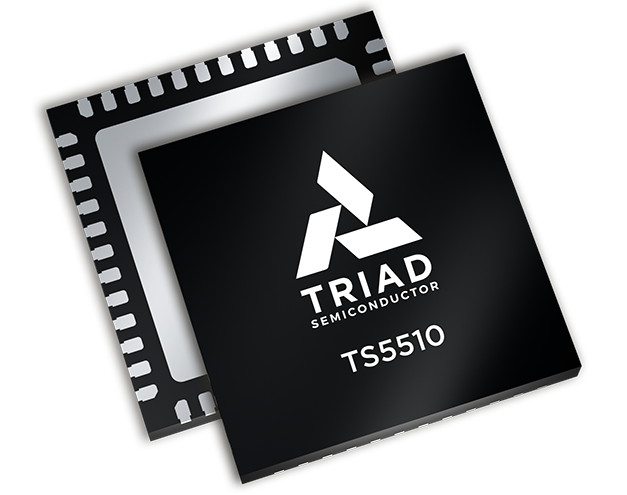
That compromise is over. The introduction of the Triad TS5510, built on a revolutionary Current Conveyor architecture, marks the arrival of the truly Universal AFE, capable of capturing every source in a single, uncompromised signal path.
Why INAs Fail the “Universal” Test
The traditional INA-based AFE faced two fundamental, conflicting demands:
1. Input Signal Headroom: To boost a low-level microphone signal, the INA topology needs high gain, which is not usually a problem. But when set to low-gain mode, applying a large line-level input signal would easily saturate and clip the internal circuitry, resulting in severe distortion, prompting designers to include a separate high-impedance “line path.”
2. Common Mode Degradation: The INA topology has a first stage that amplifies differential signals while also buffering and relaying common-mode (CM) signals to the second stage, creating potential headroom issues in the INA first stage, while passing the CM rejection problem on to a secondary stage or even the ADC itself.
The Current Conveyor: Decoupling CM from Performance
The TS5510’s Current Conveyor architecture eliminates the INA’s shortcomings by fundamentally removing CM content from the first differential input stage.
1. Consistent Headroom: The input stage has a differential current output that responds only to differential input signals, allowing the IC to handle signals up to +28dBU without clipping. This eliminates the need for external line-level bypass paths or attenuation pads. Up to 18dB of attenuation to match high-level line signals to ADC inputs is available on each channel.
2. Gain-Invariant CMRR: Because the design does not rely on resistive matching, the TS5510 maintains a consistently high CMRR (typically >90dB) across all gain settings. Your noise rejection stays solid, from -18dB of attenuation to +47dB of gain. The dual Current Conveyor architecture eliminates any potential headroom limitations (often seen when both CM and full-scale differential signals are present) by eliminating any CM signals at the input (1st) stage, while presenting the differential (wanted) signal to the 2nd stage in the current domain.
156dB Total Input Capture Range (TICR)
The TS5510’s performance can be defined by its Total Input Capture Range (TICR): the difference between the loudest signal it can handle (+28dBU) and the quietest signal it can resolve (-128dBU Equivalent Input Noise) to deliver a staggering 156dB TICR in a single component.
This means you can plug in anything — a passive ribbon mic, a high-output console, a modular synth — and the AFE will handle it with uncompromised fidelity.
Simplicity and Cost Reduction
Beyond the audio performance, the TS5510 delivers crucial system-level savings:
• PCB Footprint Reduction: The need for external gain resistors, bulky line-level bypass relays, and complex signal-switching circuitry is eliminated, resulting in a smaller PCB area and dramatically simplified Bill of Materials (BOM).
• Faster Development: Engineers no longer spend time balancing complex, temperature-sensitive dual-path INA-based designs or wrestling with external passives matching. The “Mic” and “Line” stages can now be designed as one socket.
• ADC Agnostic: The solution seamlessly supports any Audio ADC on the market, preventing vendor lock-in and simplifying your supply chain.
The TS5510 is more than a component; it’s a foundational shift that allows hardware designers to build audio equipment the way it should have always been: simple, robust, and universally compatible.